Search News
Industry Portal
Popular Tags
Intraoperative Navigation vs Robotics: What Improves Accuracy?
Author
Time
Click Count
Intraoperative Navigation vs Robotics: What Improves Accuracy?
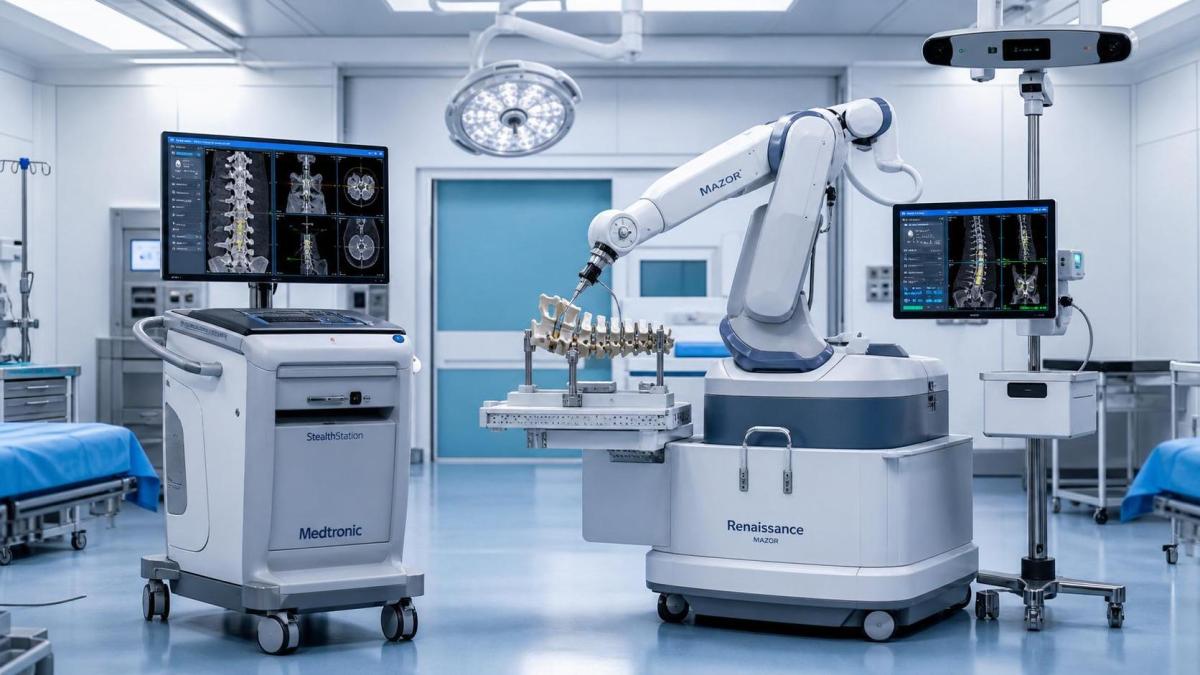
When hospitals compare intraoperative navigation with robotics, accuracy is the headline issue. Yet the better decision starts with understanding how each system creates, maintains, and verifies precision.
Intraoperative navigation gives surgeons spatial guidance. Robotic platforms add motion control, repeatability, and workflow automation. These are related strengths, but they are not identical.
That distinction matters during technical evaluation. A hospital may need better image-based orientation, not a robotic arm. Another site may need robotic execution because consistency varies across operators.
So the practical question is narrower than marketing claims. Does intraoperative navigation alone improve accuracy enough for the target procedure, or does robotics provide a measurable upgrade?
The answer depends on anatomy, imaging quality, registration stability, workflow discipline, and how accuracy is defined. In many programs, accuracy is a system outcome, not a single device feature.
What Intraoperative Navigation Actually Improves
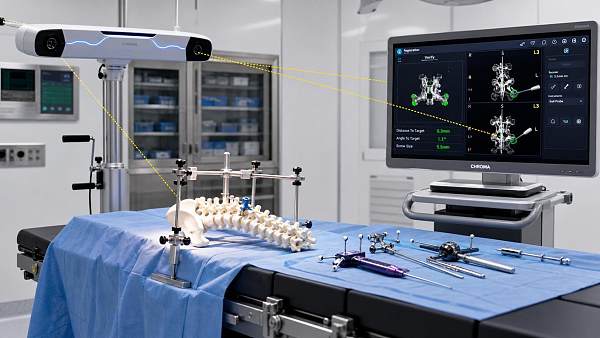
Intraoperative navigation improves visualization of instrument position relative to patient anatomy. It is especially valuable when direct line of sight is limited or landmarks are difficult to judge reliably.
The core benefit is informed decision-making. Surgeons can compare planned and actual trajectories in real time. That reduces dependence on estimation, especially in complex spinal, cranial, or ENT procedures.
Intraoperative navigation also supports smaller margins of error when registration quality is high. If anatomy shifts, however, the guidance may lose fidelity unless the workflow includes recalibration or updated imaging.
This is why intraoperative navigation should be judged as a chain. Imaging accuracy, tracker visibility, registration method, and staff discipline all influence final performance.
- Strongest value: spatial awareness during planning and targeting.
- Common limitation: navigation accuracy can drift if patient reference changes.
- Operational requirement: precise registration and uninterrupted line tracking.
- Best-fit use: procedures where guidance matters more than automated execution.
What Robotics Adds Beyond Intraoperative Navigation
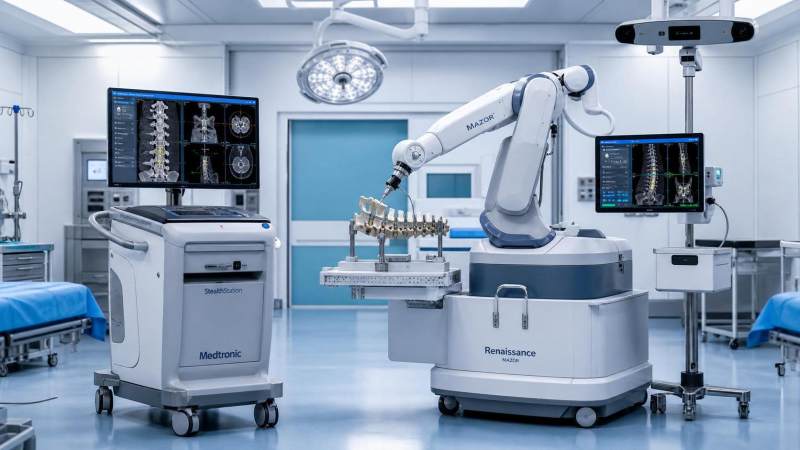
Robotics often uses intraoperative navigation as an input layer. The difference is that the robotic platform does not stop at guidance. It constrains, stabilizes, or executes movement with programmed precision.
That matters in procedures where hand variation affects results. Robotic assistance can reduce tremor, maintain angle fidelity, and improve repeatability across cases and operators.
In technical terms, robotics can turn planned accuracy into mechanical consistency. Intraoperative navigation shows where to go. Robotics helps the instrument follow that path with less deviation.
Still, robotic accuracy is not automatic. It depends on calibration, arm rigidity, registration integrity, software safety logic, and whether the surgical field changes after planning.
A robot can reproduce a flawed plan very consistently. That is why the best robotic systems combine mechanical precision with robust intraoperative navigation, verification, and fail-safe checks.
Where Robotics Usually Shows Clearer Accuracy Gains
- Pedicle screw placement requiring consistent trajectory control.
- Orthopedic alignment tasks with defined geometric targets.
- Procedures with narrow safety margins and repeatable workflows.
- Settings where operator variability is a documented issue.
Accuracy Depends on the Procedure, Not the Label
A common evaluation mistake is treating intraoperative navigation and robotics as universal accuracy solutions. In reality, each procedure has a different error profile and workflow sensitivity.
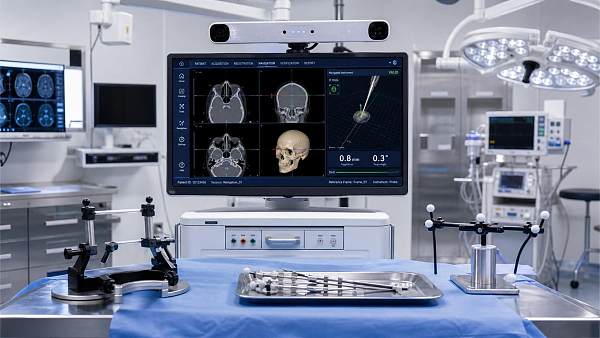
For example, intraoperative navigation may deliver excellent value in tumor localization or cranial trajectory planning. The main need there is confidence in anatomy mapping, not necessarily robotic manipulation.
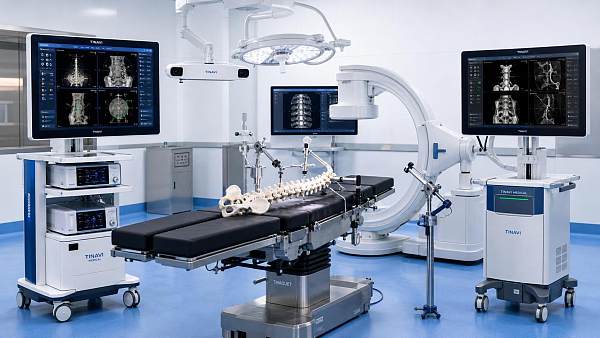
In spine surgery, the balance can shift. Intraoperative navigation improves planning and targeting, but robotics may further improve screw trajectory consistency and reduce manual deviation during execution.
Soft tissue procedures add another complication. Tissue deformation can reduce the value of preoperative maps. In these settings, intraoperative navigation may need live imaging updates to maintain accuracy.
This also means selection criteria should be procedure-specific. It is rarely enough to ask which platform is more advanced. The better question is which source of error matters most in the target service line.
Key Error Sources to Compare
- Registration error in intraoperative navigation workflows.
- Mechanical deviation or drift in robotic execution.
- Imaging quality and segmentation reliability.
- Patient movement and anatomy shift during surgery.
- Human factors during setup, planning, and verification.
How to Evaluate Intraoperative Navigation for Real Accuracy
A strong evaluation starts with measurable definitions. Accuracy may mean target localization error, implant deviation, angular variance, revision reduction, or fewer fluoroscopy checks.
Intraoperative navigation should then be tested against those metrics. The review should include not only vendor claims, but also registration workflow, recalibration burden, and compatibility with existing imaging systems.
Hospitals should also ask whether intraoperative navigation maintains performance across different surgeons and case complexity. A solution that works only in ideal scenarios may not improve real-world accuracy.
- Define the procedure and target anatomy first.
- Choose two or three accuracy metrics that matter clinically.
- Map each workflow step where error can be introduced.
- Check integration with CT, fluoroscopy, PACS, and OR data flows.
- Review training demands and recovery after workflow disruptions.
- Request evidence from similar case volumes and patient profiles.
From a procurement view, intraoperative navigation is often easier to introduce than robotics. The investment, footprint, and workflow redesign are usually lower, though the gains may also be narrower.
Decision Matrix: When Intraoperative Navigation Is Enough
In many hospitals, intraoperative navigation is the right first step. It improves orientation, supports surgical confidence, and avoids the full complexity of robotic deployment.
If the main problem is knowing where the instrument is, intraoperative navigation may be enough. If the main problem is repeating the same optimal path every time, robotics becomes more persuasive.
Integration, Safety, and Long-Term Value
Accuracy should not be separated from integration. Intraoperative navigation delivers better value when it connects cleanly with imaging, planning software, PACS, cybersecurity controls, and OR documentation systems.
Robotics raises the integration bar further. System uptime, software updates, instrument compatibility, service response, and user credentialing all affect whether theoretical accuracy survives daily operations.
There is also a safety dimension. Intraoperative navigation must show stable references and transparent alerts. Robotic systems must additionally prove safe motion control, emergency override behavior, and verification checkpoints.
Over time, the stronger investment is the platform that supports reliable adoption. A slightly less advanced system can outperform a premium one if staff trust it, use it correctly, and maintain it consistently.
Final Selection View
Intraoperative navigation improves surgical accuracy by enhancing spatial understanding and real-time guidance. Robotics can improve accuracy further when the procedure benefits from constrained, repeatable execution.
So the better choice is rarely abstract. It depends on where the current workflow loses precision. If the gap is orientation, intraoperative navigation often delivers the clearest return.
If the gap is manual consistency, robotics may justify its cost. In either case, the evaluation should focus on measured error reduction, workflow fit, integration readiness, and procedure-specific evidence.
A practical next step is to build a side-by-side scorecard. Compare intraoperative navigation and robotics across anatomy type, accuracy metrics, training load, upgrade path, and total deployment risk.
That approach keeps the decision grounded. It also makes it easier to identify when intraoperative navigation is the optimal solution, and when robotics truly adds measurable clinical precision.
Recommended News
 Aug 07, 2026How Accurate Are Surgical Navigation Systems With Optical Tracking in Spine Surgery?Surgical navigation systems with optical tracking in spine surgery can be highly accurate—but only with strong registration, stable reference frames, and disciplined workflows. Learn what really determines performance.
 Jul 25, 2026Real-Time Tracking in Surgical Navigation: Accuracy Limits and OR Workflow ImpactSurgical navigation real time tracking: learn how latency, drift, occlusion, and OR workflow shape real accuracy. A practical guide for evaluators comparing systems with confidence.
 Jul 06, 2026EU Rule Tightens MDR Deadline for IIa Ortho Nav RobotsEU MDR deadline tightens for IIa orthopedic navigation robots: from Oct 1, 2026, products without Annex XIV clinical evaluation may lose EU market access and customs clearance. See supply chain risks.
 Jul 06, 2026Surgical Navigation Systems for Spine Surgery: How to Compare Accuracy and WorkflowSurgical navigation systems for spine surgery: compare accuracy, imaging integration, workflow, training, and total cost to choose a platform that improves OR efficiency and confidence.
 Jul 05, 2026EU MDR Cutoff Ends for IIa Orthopedic Nav-RobotsEU MDR cutoff ends for IIa orthopedic nav-robots on July 4, 2026. Learn how CE certification, MDR technical documentation, and customs rules now impact EU market entry.
 Jul 04, 2026EU Reclassifies AI Orthopedic Nav-Robots as Class IIIEU reclassifies AI orthopedic navigation robots as MDR Class III. See how the July 2026 rule change impacts CE status, EU imports, market access, and undelivered orders.
 Jul 04, 2026Surgical Navigation Platform: Key Features That Reduce Revision RiskDiscover how a surgical navigation platform reduces revision risk with precise registration, real-time tracking, clear 3D visualization, and workflow-friendly integration across complex surgeries.
 Jul 04, 2026Perioperative Robotic Navigation: How to Compare Accuracy and OR FitPerioperative robotic navigation: compare real-world accuracy, OR fit, workflow impact, and integration readiness to choose a system that delivers reliable surgical value.
 Jul 03, 2026EU MDR Class III Status Extends to AI Ortho Nav RobotsEU MDR Class III now applies to AI orthopedic navigation robots. Learn how this update impacts conformity assessment, clinical evidence, EU exports, and post-market compliance.
 Jul 02, 2026EU Extends MDR Annex XVI to Orthopedic Nav-RobotsEU Extends MDR Annex XVI to Orthopedic Nav-Robots: learn how the new Class III MDR rule reshapes CE certification, clinical evaluation, costs, and market access before Oct 26, 2026.
 Jul 02, 2026When Intraoperative Navigation Improves Orthopedic AccuracyIntraoperative navigation for orthopedic surgery improves accuracy in revision joints, deformity correction, and complex implants. Learn when it truly adds value.
 Jul 01, 2026Shanghai Port Delays Stretch Medical Robotics Lead TimesShanghai Port delays are extending medical robotics lead times to 8–12 weeks. Learn how capacity cuts, customs checks, and booking pressure are reshaping export delivery plans.
 Jun 30, 2026EU Adds Orthopedic Nav-Robots to MDR Annex XVIEU adds orthopedic nav-robots to MDR Annex XVI, moving them to Class III from Oct 2026. Learn how this EU MDR update affects market access, compliance, procurement, and delivery planning.
 Jun 27, 2026Surgical Navigation Technology Trends Shaping Orthopedic RoboticsSurgical navigation technology is redefining orthopedic robotics through smarter imaging, seamless workflow integration, and measurable precision—explore the trends driving reliability, scalability, and clinical value.
 Jun 19, 2026Intraoperative Navigation for ENT Surgery: Accuracy, Workflow, and LimitsIntraoperative navigation for ENT surgery explained: explore accuracy, workflow gains, case selection, and system limits for sinus, revision, and skull base procedures.
 Jun 17, 2026Intraoperative Navigation vs Robotics: What Improves Accuracy?Intraoperative navigation vs robotics: discover what truly improves surgical accuracy, where each system performs best, and how hospitals can choose the right fit.
 Jun 14, 2026Orthopedic Medical Surgical Robots: How to Compare Accuracy and ROIOrthopedic medical surgical robots: compare accuracy, workflow fit, and ROI with a practical buyer framework for smarter hospital investment decisions.
 Jun 11, 2026Orthopedic Navigation Robot Platform Comparison: Accuracy, Setup, and OR FitOrthopedic navigation robot platform comparison made practical: assess accuracy consistency, setup time, OR fit, integration, and long-term value to choose the right system with confidence.