Search News
Industry Portal
Popular Tags
EU MDR Delay Skips AI Diagnostic Software
Author
Time
Click Count
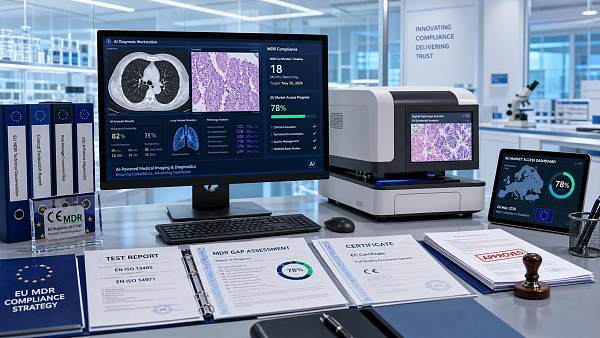
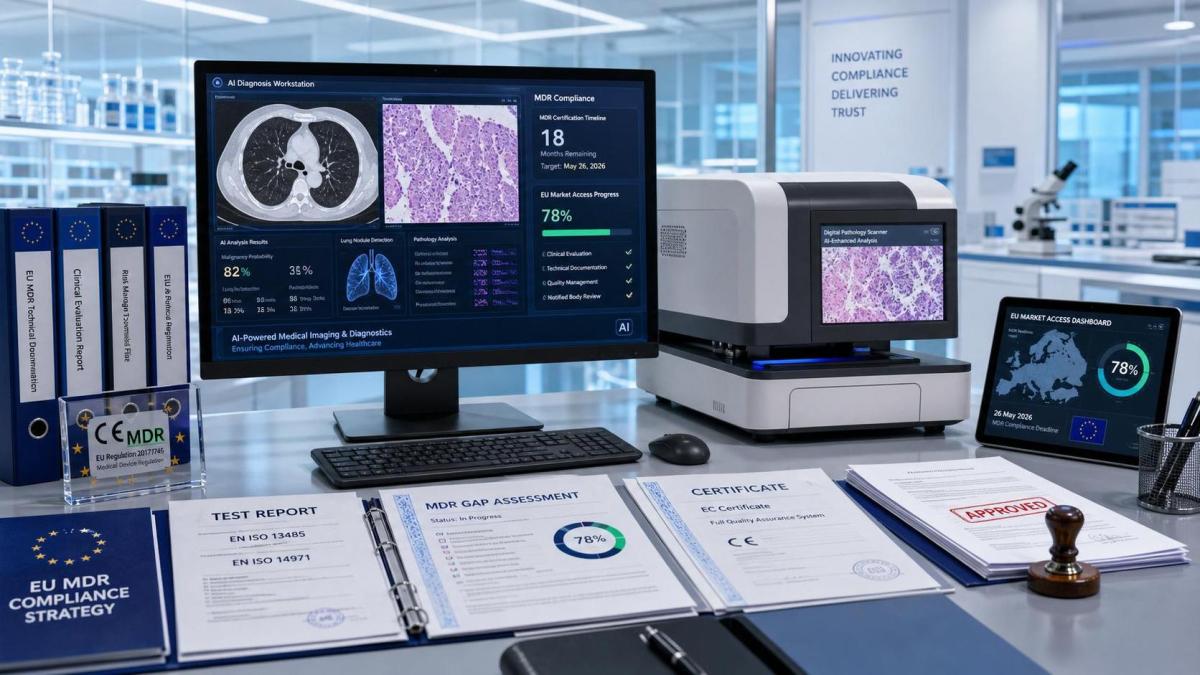
On June 28, 2026, the European Commission issued an emergency amendment, Commission Regulation (EU) 2026/1192, extending the MDR transition deadline for some Class IIa medical devices to May 26, 2028, while expressly excluding AI-assisted diagnostic SaMD, including Digital Pathology AI and Radiology AI Screening. For exporters of AI imaging software that have not yet obtained EU MDR Class IIa certification, this keeps the original July 1, 2026 enforcement point in place and turns compliance timing, distribution continuity, and certification readiness into immediate business issues rather than medium-term planning topics.
What the amendment changes, and what it does not
The confirmed change is narrow but operationally significant. According to the provided event summary, the emergency amendment released by the European Commission in the early hours of June 28, 2026 extends the MDR transition period for part of the Class IIa device category until May 26, 2028.
The same amendment also makes clear that AI-assisted diagnostic software as a medical device is not included in that extension. The excluded scope specifically includes Digital Pathology AI and Radiology AI Screening.
For those excluded products, the original mandatory enforcement date of July 1, 2026 remains unchanged. The provided summary further indicates that Chinese exporters of AI imaging software that have not yet secured EU MDR Class IIa certification must immediately begin parallel remediation work on clinical evaluation and algorithm validation, or they risk losing eligibility for EU distribution.
Where the pressure now shifts across the market
Export pipelines face a split timeline
From an industry perspective, the most direct impact falls on exporters whose portfolios include Class IIa products with different regulatory treatment under the same amendment. Some device lines may benefit from a longer transition window, while AI-assisted diagnostic software does not. This creates a practical need to separate product planning, market access timing, and shipment expectations by product type rather than treating Class IIa as a single compliance category.
What deserves closer attention is the effect on export documentation, certification status checks, and distributor-facing readiness statements. For affected AI software products, the relevant issue is no longer whether the broader Class IIa transition was extended, but whether the product is within the excluded AI-assisted diagnostic scope and whether MDR certification status is already in place.
Distributors and channel partners must reassess listing continuity
Channel participants may be affected because the summary links non-certification directly to the risk of losing EU distribution eligibility. That means distributors, import-side channel managers, and business development teams may need to revisit which software products can continue to be offered, listed, or advanced through commercial negotiations after the original July 1, 2026 date.
Observably, the business impact is likely to center on qualification review, contract execution timing, and product onboarding decisions. Any channel participant handling AI imaging software in the excluded category should pay close attention to certification status, technical file completeness, and whether current sales materials or compliance representations remain aligned with the unchanged enforcement date.
Certification and testing-related services move from support function to bottleneck
The event summary specifically points to a dual-track remediation path: clinical evaluation and algorithm validation. That means certification-related companies and testing or validation service providers may become critical to whether affected exporters can preserve market access within the remaining compliance window.
For these service-linked participants, the main issue is not general demand growth but sequencing pressure. Companies seeking to maintain EU distribution may need faster coordination between regulatory review, technical documentation preparation, and evidence packages tied to algorithm performance and clinical support.
What affected companies should check immediately
Confirm whether the product falls within the excluded AI diagnostic scope
Analysis shows the first practical question is classification in application, not just category in name. Companies should review whether their software is positioned or documented as AI-assisted diagnostic SaMD, especially where Digital Pathology AI or Radiology AI Screening functions are involved. The amendment, as summarized in the input, does not extend the transition for that excluded group.
Recheck certification readiness against the unchanged July 1, 2026 date
For companies without EU MDR Class IIa certification, the unchanged date becomes the controlling milestone for the excluded AI products. What deserves closer attention is whether current internal schedules, distributor communications, and delivery commitments were built on the assumption that all Class IIa products would receive extra time. If so, those assumptions may need immediate correction.
Prioritize clinical evaluation and algorithm validation materials
The provided summary specifically identifies these two workstreams as the urgent remediation path. Companies affected by the exclusion should therefore focus on whether supporting materials, technical documents, and validation evidence are sufficiently organized for ongoing certification work and external compliance review. This should be understood as a practical compliance priority derived from the event summary, not as confirmation of any particular review outcome.
Watch for changes in tender language and distributor qualification requests
Observably, even where formal execution details are not provided in the input, companies should monitor whether procurement documents, partner qualification checks, and product acceptance conditions begin to reflect the distinction between extended Class IIa products and excluded AI diagnostic software. This is especially relevant for businesses whose commercial process depends on proving regulatory eligibility before delivery or onboarding.
Why this reads as an enforcement signal, not a broad relaxation
Analysis shows this development should not be read simply as a general easing of MDR timing for Class IIa devices. The more important message is that the extension is selective, and the exclusion of AI-assisted diagnostic SaMD preserves immediate compliance pressure for that part of the market.
It is more appropriate to understand this as an enforcement signal with category-specific consequences. For the affected AI imaging software segment, the market issue is not abstract policy direction but whether certification, supporting evidence, and distribution eligibility can remain aligned under the original deadline. At the same time, because the input does not provide detailed implementation language beyond the amendment summary, ongoing observation is still necessary.
How this development is best understood now
In practical terms, this event separates part of Class IIa into two different regulatory timelines. Some products gain more transition time, but AI-assisted diagnostic software named in the exclusion does not. That distinction matters directly for exporters, distributors, certification-related service providers, and procurement functions dealing with AI imaging software.
At this stage, the most reasonable reading is that the change has already landed as a concrete compliance boundary for the excluded category, while many execution details still require close follow-up in market practice. The key takeaway is not a universal extension, but a narrower rule change that leaves a specific AI software segment facing immediate MDR pressure.
Basis of this article and what still needs verification
This article is generated on the basis of the user-provided news title, event date, and event summary. Relevant source types for developments of this kind typically include official notices, releases from regulatory authorities, trade or customs authorities, industry association updates, standard-setting documents, and reporting by authoritative media.
No specific official source link was provided in the input, so the precise official publication path still needs to be verified on an ongoing basis. Observably, the areas that merit continued attention include any detailed implementation wording, certification enforcement interpretation, changes in tender or procurement documents, industry feedback, and how affected companies execute remediation and market access adjustments in practice.
Recommended News
 Aug 26, 2026When does pathology AI workflow integration improve turnaround timePathology AI workflow integration improves turnaround time when it streamlines triage, review, and sign-out. Learn where labs gain real speed and what to verify before deployment.
 Jul 23, 2026How to Evaluate Digital Pathology Software for Workflow, Accuracy, and IntegrationDigital pathology software evaluation starts with workflow, accuracy, and integration. Learn how to compare platforms, reduce risk, and choose a scalable fit for clinical use.
 Jul 14, 2026Healthcare AI Analysis Tools: What to Compare Before You InvestHealthcare AI analysis buyers should compare clinical fit, data quality, integration, compliance, and vendor maturity before investing. Learn what truly drives safer ROI.
 Jul 09, 2026Pathology AI Image Analysis: Accuracy, Validation, and LimitsPathology AI image analysis explained: assess accuracy, validation, bias, workflow fit, and regulatory limits to compare vendors smarter and reduce deployment risk.
 Jul 08, 2026Digital Pathology Imaging: 7 Factors That Affect Scan Speed and Image QualityDigital pathology imaging explained: discover 7 critical factors that shape scan speed, image quality, AI readiness, and workflow efficiency before choosing or upgrading a scanner.
 Jul 06, 2026FDA Tightens SaMD Path for AI Pathology SoftwareFDA Tightens SaMD Path for AI Pathology Software: learn how the new FDA rule on dynamic de-identification validation could delay 510(k) or De Novo filings and reshape U.S. market entry.
 Jun 28, 2026EU MDR Delay Skips AI Diagnostic SoftwareEU MDR Delay skips AI diagnostic software: learn why Digital Pathology AI and Radiology AI Screening still face the July 1, 2026 deadline, and what exporters must do now to protect EU market access.
 Jun 17, 2026VITURE Helix Signals Compliance-First XR AI in Clinical UseVITURE Helix Signals Compliance-First XR AI in Clinical Use highlights HIPAA- and IEC 62304-aligned XR AI for medical workflows, traceability, and secure deployment—see why it matters for integrators and buyers.
 Jun 17, 2026Medical AI for Oncology: 5 Use Cases That Matter in 2026Medical AI for oncology in 2026: discover 5 high-impact use cases shaping faster triage, smarter treatment planning, and connected cancer care workflows.
 Jun 15, 2026Tempus Open-Sources Paige IMS as Pathology AI Standards AdvanceTempus open-sources Paige IMS, signaling a new phase for pathology AI standards, interoperability, and multi-vendor integration. See what it means for hospitals and global market entry.